Thailand continues to attract entrepreneurs and foreign investors thanks to its strategic location, strong infrastructure, skilled workforce, and direct access to ASEAN markets. But before you incorporate and start trading, there are several legal requirements that can make or break your launch — and they are often more complex for foreign nationals than they appear at first glance.
Key Considerations Before You Start
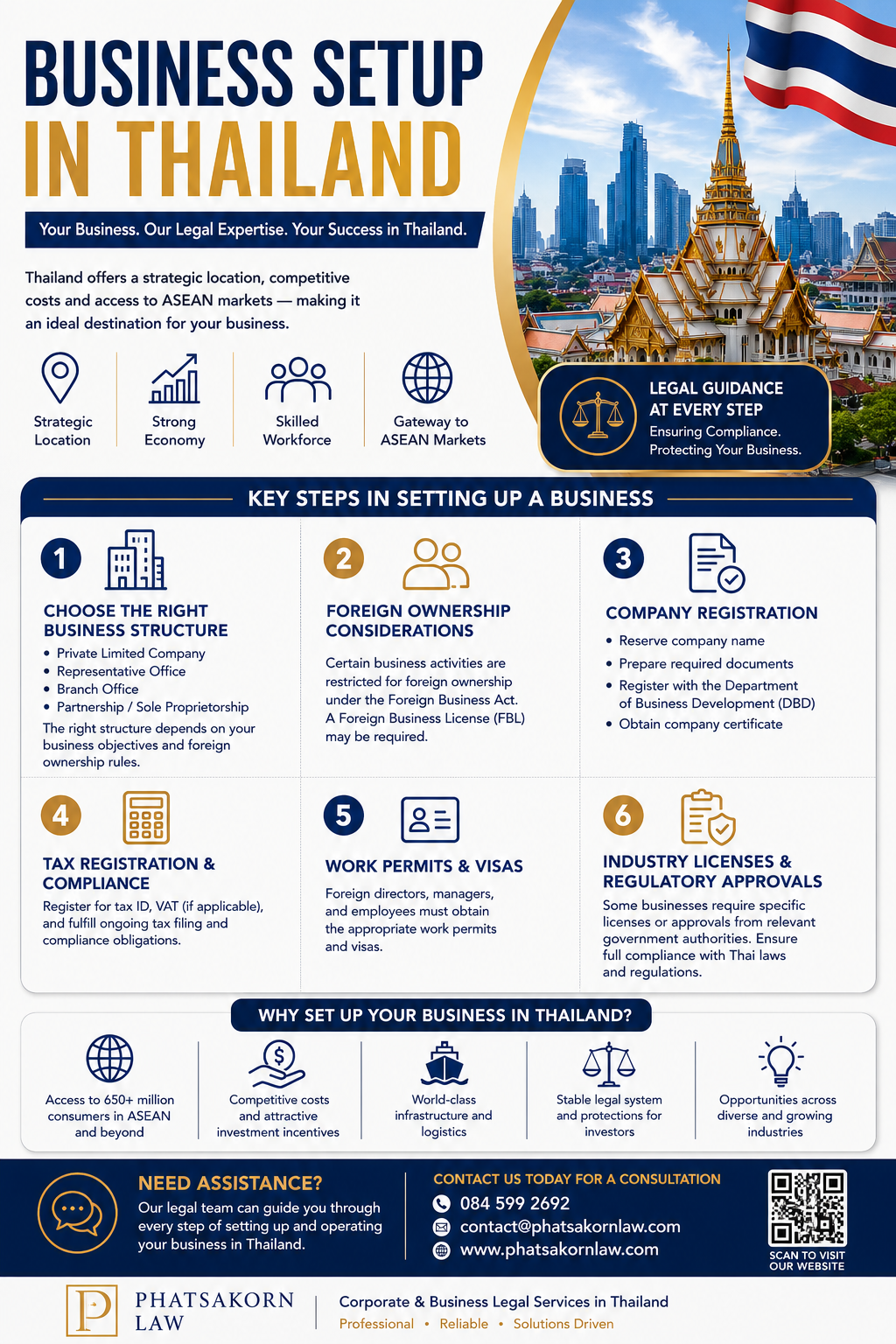
There are six areas every entrepreneur should address before registering a company in Thailand:
Understanding the Foreign Business Act
One of the most common obstacles for foreign investors is the Foreign Business Act B.E. 2542 (1999). Under this law, business activities are divided into three lists — and activities on Lists 2 and 3 require a Foreign Business License before a majority-foreign-owned company may operate legally.
Common restricted activities include trading, retail, construction, hotel services, accounting, advertising, and legal services. Entering these sectors without the correct license — or structuring around the rules using nominee shareholders — carries serious civil and criminal exposure.
Identify Your Business Activity
Determine whether your intended business falls under one of the restricted lists. This single step shapes every subsequent decision — structure, licensing, timeline, and cost.
Choose Your Structure
A Thai Private Limited Company requires a minimum of three shareholders and at least 25% paid-up capital. BOI promotion can allow 100% foreign ownership in qualifying industries. Each structure has different tax and operational implications.
Register with the Department of Business Development
The Memorandum of Association must be filed, followed by a statutory meeting and formal registration. The process typically takes 5–10 business days once all documents are in order.
Register for Tax and VAT
Companies must register for corporate income tax within 60 days of incorporation. VAT registration is required once annual revenue reaches THB 1.8 million. Ongoing monthly and annual filing obligations apply from day one.
Obtain Work Permits for Foreign Staff
A work permit requires a Non-Immigrant B visa as a prerequisite. The company must also meet a 4:1 Thai-to-foreign employee ratio and minimum capital requirements. Applications are filed with the Department of Employment.
Why Legal Advice Matters at the Start
Many foreign entrepreneurs make the mistake of treating company registration as a paperwork formality. In Thailand, the structure you choose and the licenses you hold (or fail to hold) have long-term consequences for your tax position, your ability to employ foreign staff, your banking relationships, and your personal liability as a director.
Getting the structure right from day one is significantly cheaper than restructuring an operating company after a compliance problem emerges.
Ready to Set Up Your Business in Thailand?
We assist foreign entrepreneurs and investors with company registration, Foreign Business Licenses, BOI applications, work permits, and ongoing corporate compliance — all communicated in English.
contact@phatsakornlaw.com +66 84 599 2692LINE: @phatsakornlaw
— Atty. Phatsakorn, Phatsakorn Law Office