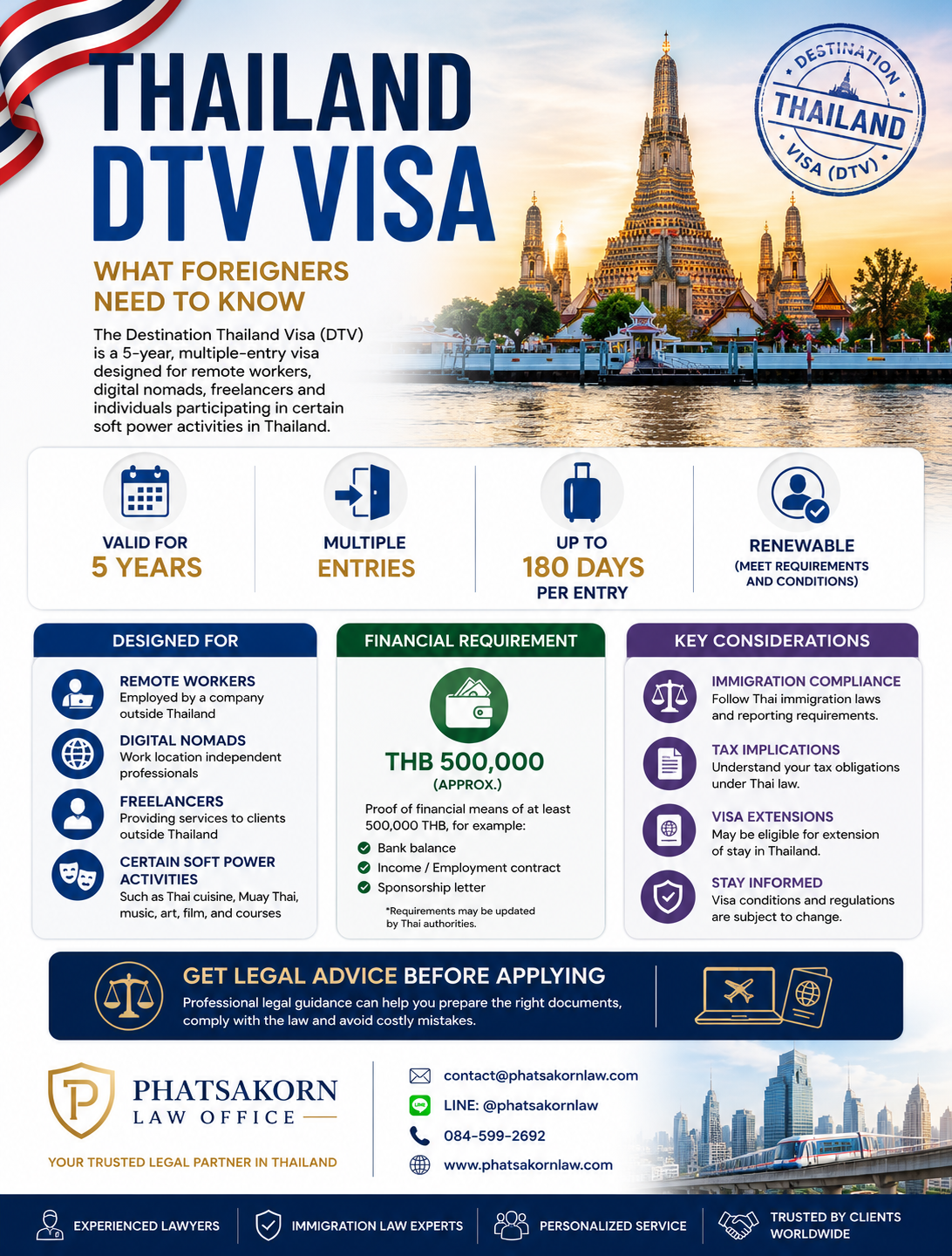
Thinking of living in Thailand while working remotely? Thailand's Destination Thailand Visa (DTV) allows eligible foreigners to stay for up to 180 days per entry, with multiple entries over a 5-year visa validity period. It is designed for digital nomads, remote workers, freelancers, and those engaged in certain cultural or educational activities.
Eligibility Requirements
The DTV Visa is available to foreign nationals who fall into one of the following categories:
- Remote workers and digital nomads — those employed by or contracted with a foreign company and working remotely
- Freelancers — independent contractors providing services to clients outside Thailand
- Cultural and creative activities — participants in Thai boxing (Muay Thai), traditional arts, music, or cooking courses
- Educational and seminar participants — attendees of courses, conferences, or study programs in Thailand
- Medical wellness visitors — those coming for long-term medical treatment or wellness programs
Applicants must also meet the following baseline conditions:
Financial Evidence Requirements
Demonstrating adequate financial means is one of the most scrutinized parts of the DTV application. Embassies look for genuine financial stability — not a sudden deposit made shortly before applying.
Minimum Bank Balance: 500,000 THB
Applicants must show a bank balance of at least 500,000 THB (approximately USD 13,500–16,000 depending on the exchange rate). The funds must be in a personal bank account in your name.
Consistent Balance for 3–6 Months
Most embassies require bank statements covering the past 3 to 6 months. A large deposit made immediately before application is a common rejection trigger — the balance should reflect genuine savings, not a temporary transfer.
Employment or Income Documentation
Supporting documents — such as a remote employment contract, freelance service agreements, or proof of business ownership — should accompany the financial evidence. Unclear income records are a common cause of rejection.
What You Can — and Cannot — Do Under the DTV
Understanding the scope of permitted activities is critical. Working unlawfully in Thailand — even remotely — can have serious consequences.
Tax and Immigration Considerations
This is the area most DTV holders underestimate — and where legal advice is most important.
Thai Tax Residency
Under the Thai Revenue Code, any individual who resides in Thailand for 180 days or more in a tax year is considered a Thai tax resident. As a tax resident, you are liable to pay Thai personal income tax on:
- Income earned from sources within Thailand
- Foreign-sourced income brought into Thailand in the same tax year it was earned
Double Taxation Treaties
Thailand has tax treaties with over 60 countries. If your home country has a treaty with Thailand, certain income may be exempt or subject to reduced withholding. However, treaty relief is not automatic — you must actively claim it and, in many cases, file a Thai tax return.
Extension and Reporting Obligations
Holding a DTV Visa does not mean you can stay indefinitely without taking action. Two ongoing obligations apply from the moment you enter Thailand:
In-Country Extension: Up to 180 Additional Days
Each 180-day entry can be extended once for an additional 180 days at a Thai Immigration office. The extension requires updated financial evidence — the same 500,000 THB bank balance — along with your passport and the applicable fee. This must be done before your current permission to stay expires.
90-Day Reporting
Any foreigner staying in Thailand for 90 consecutive days or more must file a 90-day report with the Immigration Bureau — either in person, by mail, or online. Failure to report carries a fine of 2,000 THB per violation. This obligation continues throughout your stay and resets after each 90-day period.
TM30 Notification by Accommodation Provider
Under Thai immigration law, the owner or manager of any residence — including rented apartments and condominiums — is required to notify Immigration of a foreign national's presence within 24 hours of arrival (TM30 form). If your landlord is unfamiliar with this obligation, you may need to assist them or file it yourself.
Planning a Long-Term Stay in Thailand?
We assist foreign nationals with DTV Visa applications, immigration compliance, 90-day reporting, and tax residency planning — all in English. Get it right from the start.
contact@phatsakornlaw.com +66 84 599 2692LINE: @phatsakornlaw
— Atty. Phatsakorn, Phatsakorn Law Office